Prestige Windgates master plan image
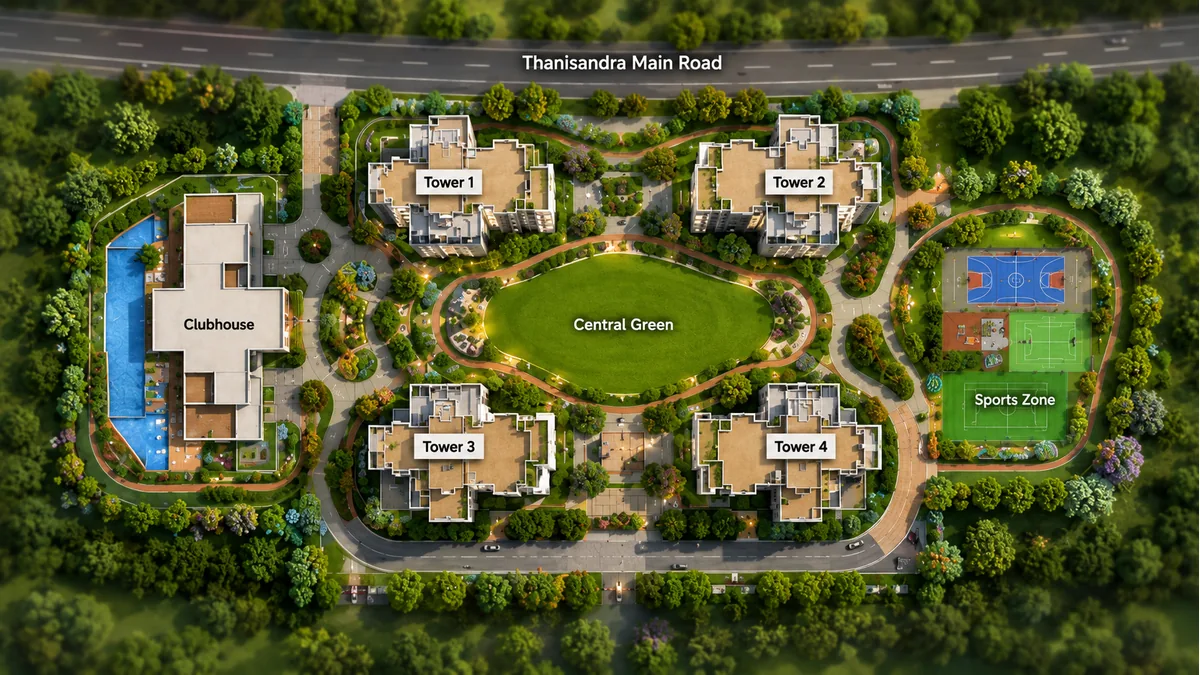
For buyers, the master plan is where a project's daily-living quality is decided long before the first apartment is fitted out. The spacing between towers, the separation of vehicles from pedestrians, the placement of the clubhouse, and the open-space ratio determine whether a community feels generous or cramped. Prestige Windgates is planned for the generous end of that spectrum.
| Element | Detail |
|---|---|
| Total land area | ~7 acres |
| Open space | ~80% |
| Towers | 4 |
| Floors per tower | G+31 (approx. 89 m) |
| Total units | ~750 |
| Per-tower units | ~180 / 190 / 180 / 200 |
| Clubhouse | Standalone, ~45,000+ sq ft amenity suite |
| Parking | Basement + podium-level, ramp-fed |
| Vehicle entry | Thanisandra Main Road frontage |
| Internal core | Pedestrian-prioritised central green |
The open-space strategy
The defining number of the Prestige Windgates master plan is the ~80% open space. On a roughly 7-acre parcel, that means only about a fifth of the ground carries the building footprints; the remaining four-fifths is landscape, amenity, and circulation. This ratio is achieved through the tower geometry — four tall G+31 towers occupy far less ground than the same unit count spread across squat, mid-rise blocks would.
The freed ground is programmed as a layered landscape rather than left as residual space. The central green is the heart of the campus — lawns, walking and jogging loops, seating courts, and shade planting — flanked by the active amenity zone (pool, sports courts, play areas) and the calmer wellness and senior zones. The "breeze-harvesting" tower spacing, the deliberate gaps engineered between the four towers, does double duty: it opens sight lines and daylight across the campus, and it channels airflow through the community so that the apartments get cross-ventilation and a daylight aspect.
This is the single most consequential design decision in the project. A high open-space ratio is not just an aesthetic — it lowers the perceived density, it gives children and seniors safe ground-level space, it improves the microclimate, and it protects the long-term resale appeal of the community against the wall-of-towers character that crowds many corridor projects.
Tower geometry
The four towers are arranged at the edges and corners of the parcel, with the clubhouse and the central green between them. Each tower rises G+31 — approximately 89 metres — making them among the taller residential towers on the corridor. The tall-and-thin profile is what makes the 80% open space possible: a slender floor plate stacked high carries the unit count while occupying minimal ground.
The per-tower unit distribution is modest. Spreading roughly 750 units across four towers (approximately 180, 190, 180, and 200 units) keeps each tower's per-floor count low — which directly improves the daily experience. A low per-floor count means shorter elevator waits at the 8-9 AM Manyata-commute peak, less crowding in the lift lobbies, and a quieter common-corridor environment. Each tower is served by multiple high-speed elevators sized for peak-morning traffic, with separate service-lift provision.
The tower placement is oriented to maximise the daylight and cross-ventilation benefit of the breeze-harvesting spacing — apartments are planned as dual-aspect plates wherever the geometry allows, so that cross-ventilation works in both wind directions and most homes get a green or open view rather than a tower-facing one.
Circulation and parking
The master plan separates vehicle movement from pedestrian movement — a hallmark of well-planned Prestige communities. Vehicle entry is from the Thanisandra Main Road frontage, through a gated, security-managed gateway. From the entry, a perimeter driveway loops the campus and feeds the basement and podium parking ramps, keeping vehicular traffic to the edges and the parking levels.
The internal core — the central green, the clubhouse approach, the pool deck, and the play areas — is pedestrian-prioritised. Residents move from the towers to the amenities along landscaped walkways without crossing the main vehicle routes. This separation is a safety feature for children and seniors and a calm-environment feature for everyone: the noise and risk of vehicle movement is held to the perimeter and the basement, not the heart of the community.
Parking is provided across basement and podium levels, ramp-fed from the perimeter driveway, with visitor parking provisioned separately. The parking strategy is sized to the unit count with the covered-bay allocation standard for the configuration mix.
Amenity zoning
The amenity programme is anchored by a standalone clubhouse — a ~45,000+ sq ft amenity suite built as a dedicated structure rather than folded into a residential tower's podium. Building the clubhouse standalone is a deliberate choice: it isolates amenity noise (the gym, the games room, the banquet hall, the pool plant) from the apartments, and it gives the amenities meaningful programmable space across multiple floors. The master plan zones the amenities into three bands:
- Active zone — the resort-style swimming pool and kids' pool, the tennis and multipurpose sports courts, the cricket net, the skating rink, and the children's play areas. Positioned for easy access from the towers but acoustically buffered from the apartments.
- Wellness and social zone — the clubhouse interior (gym, fitness studio, indoor games, mini theatre, banquet and multipurpose halls, café, co-working lounge, library, salon, yoga and meditation pavilion). The clubhouse is the social destination of the community.
- Calm zone — the senior citizens' garden and seating courts, the meditation spaces, and the quieter landscape pockets, positioned away from the active play and sports zones to give senior residents and quiet-seekers their own ground.
The central green ties the three zones together, with the walking and jogging loops, the amphitheatre / event lawn, and the pet park threading through the landscape. The amenities page details the clubhouse programme and each facility in full.
Engineering and utility systems
The master plan integrates the campus's utility and sustainability systems at the planning stage rather than retrofitting them:
- Sewage Treatment Plant (STP) — sized for the full ~750-unit load; treated water is recirculated for landscape irrigation and toilet flushing, reducing the community's fresh-water draw.
- Rainwater harvesting — roof and surface runoff is captured into harvesting pits and percolation zones, recharging groundwater and cutting monsoon runoff.
- Solar / energy-efficient common-area lighting — reduces the common-area power load and, with it, the monthly maintenance bill.
- Diesel-generator (DG) power backup — backup power provisioned for the apartments and common areas.
- EV-charging readiness — the parking levels are provisioned for electric-vehicle charging infrastructure, future-proofing the community for the EV transition.
- Water management — BWSSB supply complemented by on-site storage and treatment.
These systems are routed and sized in the master plan so that the campus runs efficiently from handover, with a lower per-flat maintenance load than retrofitted communities.
Security and access
The master plan provides a single gated, security-managed entry from Thanisandra Main Road, with three-tier security: perimeter and gate control, CCTV coverage across the campus, lift lobbies, and parking levels, and apartment-level access control with video door phones. Visitor management is integrated at the gateway. The single-gateway design — rather than multiple uncontrolled entries — is a security best practice that keeps access auditable.
How the master plan translates to daily living
The master plan choices compound into a specific daily experience:
- The open ground gives residents — especially children and seniors — genuine outdoor space, not just walkways between buildings.
- The low per-floor unit count means the morning elevator and lobby crush that defines high-density projects is materially reduced.
- The vehicle-pedestrian separation means the school run, the morning walk, and the children's play happen away from traffic.
- The standalone clubhouse means the amenities are a destination with real space, not a token podium floor, and the amenity noise stays out of the apartments.
- The breeze-harvesting tower spacing means most apartments get cross-ventilation, daylight, and an open or green view rather than a tower-facing wall.
The Prestige Windgates master plan is a low-ground-coverage, high-open-space, amenity-led layout — planned for the generous, family-and-investor-friendly end of the Thanisandra Main Road market. The floor-plans page details the apartment layouts within the towers; the amenities page details the clubhouse and outdoor programme; the gallery page renders the master plan visually.
Prestige Windgates master plan FAQ
How many towers does Prestige Windgates have, and how tall are they?
Four towers, each rising G+31 (approximately 89 metres), arranged at the edges and corners of the roughly 7-acre parcel with the clubhouse and central green between them. The tall-and-thin profile is what frees close to 80% of the ground for open landscape.
How much open space does Prestige Windgates have?
Close to 80% of the approximately 7-acre site is left open — only about a fifth carries the building footprints. The freed ground is programmed as a layered landscape: a central green, the active amenity zone, and the calm wellness and senior zones, with the breeze-harvesting tower spacing channelling airflow through the campus.
How is parking and circulation handled at Prestige Windgates?
The master plan separates vehicle and pedestrian movement. Vehicle entry is from the Thanisandra Main Road frontage through a gated gateway, with a perimeter driveway feeding basement and podium parking ramps. The internal core — the central green, clubhouse approach, pool deck, and play areas — is pedestrian-prioritised and traffic-free.
What sustainability systems does the Prestige Windgates master plan include?
A Sewage Treatment Plant with treated-water reuse for irrigation and flushing, rainwater harvesting and groundwater recharge, solar / energy-efficient common-area lighting, DG power backup, and EV-charging-ready parking — all integrated at the planning stage for a lower per-flat maintenance load.
Where is the clubhouse positioned in the Prestige Windgates master plan?
The standalone clubhouse (~45,000+ sq ft) sits within the central amenity zone between the towers — a freestanding structure rather than a tower podium floor. This isolates amenity noise from the apartments and gives the amenities programmable space, while keeping every tower a short, walkable, traffic-free route from it.
Talk to the Prestige Windgates team
Request the master-plan layout, the tower positions, and the open-space detail, or book a site visit on Thanisandra Main Road ahead of the launch.
Contact us